US market · five engines

An AEO agency
for K-beauty brands
selling in the US.

A serum can outsell three American brands at home and still not be named in the English answer to “best Korean serum for acne-prone skin”. SearchD measures that gap across five engines and works the pages those answers are built from: corrections published where you own the page, and requested, with your specification behind them, where someone else does.

  • 5 enginesChatGPT, Perplexity, Claude, Gemini, Google AI Overviews — how the panel is built
  • 1 weekof live readings, then your panel is agreed and frozen — the first week
  • 0 / 17our own named rate, per engine, 8 September 2026 — the reading
  • No case studyno client result to show yet — why

From a missing recommendation to specific work

What you can ask SearchD to do.

SearchD helps Korean beauty brands address English-language AI answers for US buyers. An engagement combines the work your questions call for: diagnose the gap, correct product information, and strengthen the evidence behind the answer.

01 / Recommendations

Find why the brand is missing.

If English content has been published for months but mentions remain flat, we compare the buyer questions, named competitors and cited sources before recommending more content.

What comes back: a question-level baseline, source gaps, prioritized edits and a follow-up record.

Explore the diagnostic work
02 / Product and retail facts

Correct the information US shoppers receive.

A missing Target listing, an old ingredient list and a wrong shipping origin need a verified fact and a source owner. SearchD prepares approved page edits and third-party correction requests.

What comes back: the wrong statement, current US evidence, correction wording and an owner for each action.

See the correction process
03 / Reviews and media evidence

Connect existing evidence to the buyer question.

Korean reviews and US coverage can exist without appearing in an answer. We compare the material with actual citations, then prepare attributable English evidence and focused source-owner requests.

What comes back: a source-to-answer map, supported facts, unresolved gaps and the next work for your brand or PR team.

See the evidence and citation work

Keep your SEO or PR team. Make the additional work explicit.

SearchD does not replace a Google rankings programme simply because an AI answer omits the brand. We identify the buyer question, the source involved, the proposed change and its owner, then share that record with your existing team. Publishing an edit, receiving a publisher’s acceptance and being named in an answer are tracked separately.

Wrong facts

Why do AI answers get our Korean product’s facts wrong?

AI answers state a Korean product’s facts wrong when they carry a figure from a page that has it wrong. SearchD reads that pairing directly: each panel run records the statement an engine made about your product and the sources that answer cited, so a wrong SPF value and the marketplace listing carrying it come back together.

Google documents the retrieval underneath that for its own AI features — pages pulled from the Search index, the response generated from the information on them (Google Search Central, updated 10 July 2026). It documents nothing about the four other engines SearchD measures, which is why the evidence page reads it as a floor rather than a ceiling.

Where the page behind a wrong figure is one you do not control, the deliverable is a correction addressed to whoever owns it. There is no complaints desk at ChatGPT.

Checked first on a K-beauty account

  • Whether the sun-protection value an answer states matches the US-facing figure your compliance owner approved
  • Whether the ingredient list it quotes matches your US formulation
  • Whether shipping origin and delivery time match where your stock ships from today
  • Whether retailer, Amazon US, TikTok Shop and direct availability match where the product is sold today

What comes back

  • The wrong statement, verbatim, per engine
  • The URL it was taken from
  • Who owns that page, and the correction addressed to them
  • The sunscreen case, worked end to end
Product factWhere a US answer can take it fromWho controls that pageWhat SearchD does about it
SPF and sun-protection claimsA US retailer listing, or an English round-up restating an earlier figureThe retailer or the publisherPublish the US-facing figure your compliance owner confirms, then request the correction citing it
Ingredient listA marketplace listing written at first importYour distributor, where one holds the listingCheck it against the US formulation and document any real difference
Country of origin and manufacturerYour about page, or marketplace metadata, whichever an engine reached firstMostly youState it once, identically, on a page you own, and make every listing agree
Whether you sell in the US at allPages old enough to predate your retailer, marketplace or direct channelsMixed — retailers, marketplaces, youPublish the current US channel list, dated, so each channel has something newer to cite
Shipping origin and delivery timeListing copy written before you warehoused stock in the USYou and the marketplaceRequest the listing correction, and say on your own site where orders ship from
Reviews and ratingsEnglish-language review sites and category round-upsThird parties, entirelyOff-site work: get the product into the round-ups answers are built from

A page you own is corrected as soon as you approve the change; a retailer’s listing needs the retailer to agree first, so the two halves are scoped separately and the off-site ones re-checked monthly.

Not recommended

Why doesn’t AI recommend our K-beauty brand when US shoppers ask?

AI does not recommend a K-beauty brand to US shoppers when the pages behind that answer do not mention it. That pairing is what SearchD’s panel records, answer by answer and engine by engine: who was named instead of you, and which sources that answer cited.

Google documents the retrieval behind its own AI features (Google Search Central, updated 10 July 2026). SearchD does not assert a mechanism for the other four engines it measures; it reports what each of them returned.

The five causes below are checked independently and can hold at once — a page can be JS-only, short of a citable passage and unresolved between name variants together — so the diagnosis names the ones that apply and the order to repair them in. Their remedies are different pieces of work, which is why the order matters.Four structural causesare written up in full;the short version is here.

OrderCause we checkTime to rule out
01Crawlers blockedA bot rule returns 403, or the page needs JavaScript to show its text.5 min
02Nothing quotableReadable, but no paragraph survives being pulled out of the page.15 min
03Entity unresolvedYour name exists in several forms. None of them wins.1 hour
04Nobody corroboratesOnly your own site states your specification.half a day
05Competitor owns corpusYou are absent from the reading list, not from the market.days
Cheapest first, because a diagnosis that starts at the bottom spends the budget before it reaches the answer. These are the windows we scope against, not measured averages — we have run no client audits, so there is no average to publish.

English pages, still absent

We rank on Google and have English pages. Why don’t AI answers mention us?

SearchD cannot diagnose a missing AI mention from a Google ranking or the existence of an English page. The audit records three observations before deciding what to change: the response to a live crawler request, the product facts returned in raw HTML and whether one paragraph answers the buyer question without the copy around it.

The audit returns the observed failure rather than prescribing more translated copy. How ChatGPT reaches a website documents the crawler test used for ChatGPT; what makes a passage citable explains SearchD’s writing test.

  • Reachablea live crawler request returns the page
  • Readablethe current product facts are in the initial HTML
  • Quotableone passage answers one buyer question completely

Reputation you already have

We have US press and thousands of Korean reviews. Why don’t the answers use them?

US answers about your brand do not use your Korean reviews when those reviews are not among the sources the answers cite. SearchD reads that from the run log rather than assuming it: every run records each source an answer cited, on all five engines. Google documents the retrieval behind its own AI features (Google Search Central, updated 10 July 2026).

The question SearchD puts to that log is whether Hwahae, Naver, Olive Young or the Korean trade press appear in it at all, and whether a press feature that does appear carries a specification an assistant can quote. Where they do not, the work is getting checkable English statements onto the surfaces those answers cite.Alternatives and fit routes the decision without assuming the answer is SearchD.

Seven surfaces one answer is assembled fromsample

  • Your siteyours to write
  • Amazon listingyours to correct
  • Retailer pagesyours to correct
  • Review round-upssomeone else's
  • Reddit threadssomeone else's
  • YouTube reviewssomeone else's
  • Korean reviewswritten, wrong language

How many you write

1/7is a page you controlThe other six decide the shortlist.
You write one of these seven. Two more you can get corrected; four are written by other people. Which rows apply to you is what an audit establishes, and the last four rows are the work.

For every cited source a run also records whether the page carries a visible date and whether the specification on it is your current one, because a dated page is something a correction request can point at.

US launch

We launch in the US next quarter. What has to happen before then?

Before a US launch next quarter, SearchD finishes the half of the work you control and starts the half that waits on other people. Ourpublished scope puts the first in weeks and the second in months, which is why SearchD does not promise the second half by a launch date.

What can land before launch

  • A pre-launch baseline, so month one is measurable against something
  • Your US specification published as text, not an image or a PDF
  • One brand string, resolved in schema, on every page
  • Pages written for the questions your category is asked
  • Crawler access confirmed from outside your network

What will not be finished

  • Inclusion in the round-ups an answer cites — an editor has to agree
  • A corrected retailer listing, where the retailer owns the page
  • A body of English reviews, which needs buyers first
  • A moved named rate: SearchD’s published re-measurement window is 30 to 60 days after the on-site work ships

The cheapest way to find out where you stand first is thefree report: 20 buyer questions across five engines, run by hand, returned within 48 hours.

Same name, different company

How does AI tell our Korean brand apart from a US company with the same name?

Where a Korean brand shares a name with a US company, each engine’s answer describes whichever of the two the pages it cited describe — and SearchD records, question by question, which company was described, the sources cited for it and the spelling used. Evidence split across two or three romanisations leaves no single spelling with enough behind it: a legal name, a location, a founding year, a founder, stated the same way on pages you own and repeated somewhere that is not you.

SearchD asks the questions where the names collide and records what each engine described, the sources it cited and the spelling it used. The deliverable is one canonical spelling on pages you own, with the others pointed at it. Entity resolution is the mechanism SearchD is named after.

The same check catches AI attributing product imagery to another company or omitting the founder’s link to the brand. SearchD records the wrong relationship and the page cited for it, then prepares one clear company, founder and product record for every page you control.

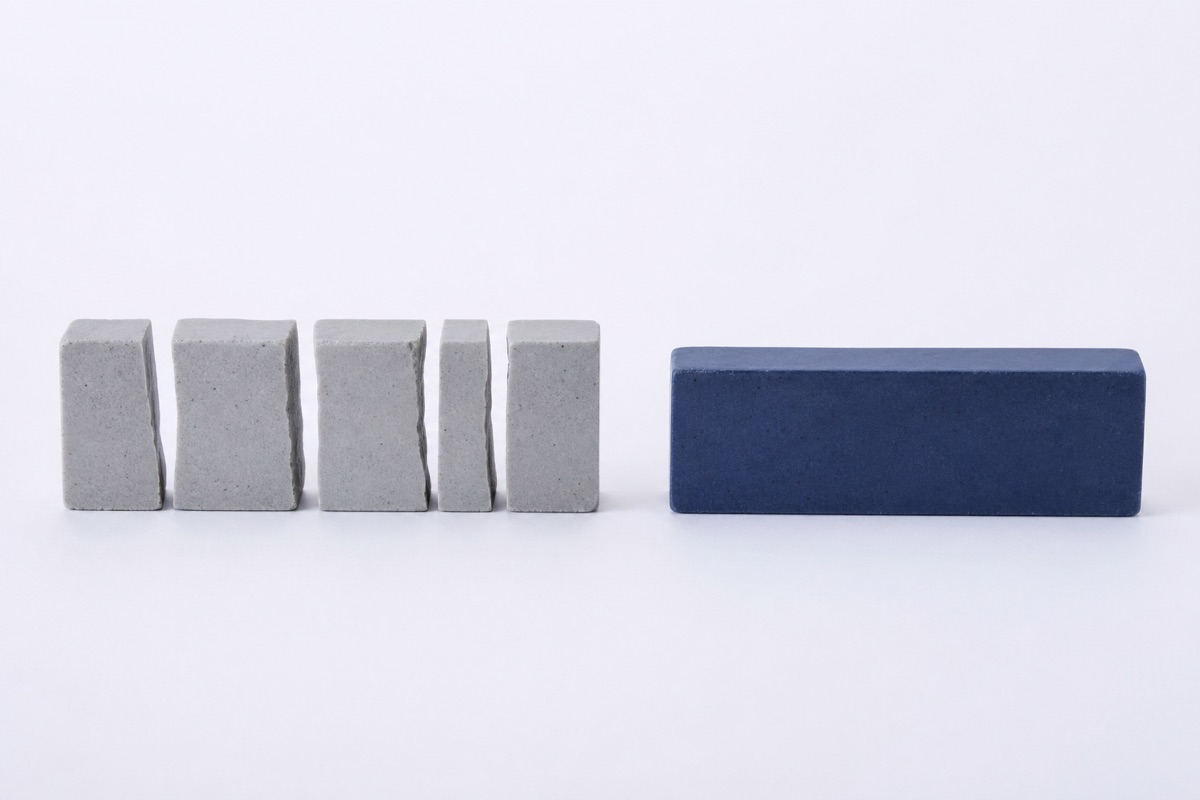
Five broken pieces of one grey stone bar stand apart with gaps between them, their fracture faces still matching; beside them the same bar whole and unbroken in deep blue. The five stand for one brand written five ways — Seolwha, SEOLWHA Co., Ltd., 설화, Sulhwa and @seolwha_official — with the evidence for it divided five ways so each looks thin. The whole bar is that same evidence pooled behind a single name.
One brand written five ways — Seolwha, SEOLWHA Co., Ltd., 설화, Sulhwa, @seolwha_official — divides the evidence between five identities, so each looks too thin to cite. Names are placeholders. Resolution does not add to what is written about a brand; it changes how much of it counts as being about the same brand.

One week in, one week out

Why does our K-beauty brand appear in AI answers one week and disappear the next?

SearchD cannot attribute a K-beauty brand’s one-week appearance or disappearance in AI answers from one generated response. SearchD’s published method freezes the buyer-question panel and re-runs it monthly per engine, so one output stays one reading rather than a claimed result.

How to check whether ChatGPT mentions your brand defines the repeatable instrument. The first month is the comparison point; there is no universal named-rate benchmark that makes a different category or question set comparable.

  • Same questionsthe panel wording stays fixed
  • Per engineChatGPT is not averaged together with another system
  • Monthlyone favourable answer is not reported as progress

Price and timing

What does this cost for a K-beauty brand, and how long before anything moves?

SearchD publishes no rate card for K-beauty work — theaudit is a fixed price quoted up front and the retainer is priced per market with no minimum term — and its published windows are 48 hours for the free report, four weeks for the audit, 30 to 60 days to the first re-measurement of your panel, and three to six months for off-site corroboration.

What moves the price: how many markets the panel covers, how many of your product facts sit on pages you do not control, and whether a compliance owner has to sign off before anything is published. What moves the timing is which half of the work a change sits in — your own pages, or someone else’s.

Other vendors in this category do publish ranges, from monitoring subscriptions to mid-market retainers. Alternatives and fit sets them out with their sources, so the comparison is one page away rather than restated here.

  • 48 hoursfree report back
  • 4 weeksaudit, start to presentation
  • 30–60 daysfirst re-measurement after on-site work ships
  • 3–6 monthsoff-site corroboration

Those four are SearchD’s published scope rather than measured outcomes: thereport and audit pages publish the first two, and the method sets out all four stage by stage.

Checking the vendor

How do we check whether an AEO agency’s results are real?

SearchD checks an AEO agency’s published result against five things, and a result missing any one of them cannot be reproduced from outside the agency that published it. SearchD holds its own numbers to that list, onits evidence page.Seven agencies serving this buyer are set against their own published pages, checked on 11 September 2026.

  • The baseline figure, and the date it was taken
  • The calendar date range of the result
  • The full question list, not a count of questions
  • The measurement tool and its version
  • A named person at the client attesting to the figure

Applied to us

0 of 17 buyer questions named SearchD on each of ChatGPT, Claude and Gemini — three per-engine readings of 0 / 17, recorded 8 September 2026 andpublished monthly, including the months it goes the wrong way. There is no K-beauty case study here because there is no K-beauty client yet.

Google states, in guidance updated 10 July 2026, thatno third-party tool has access to its ranking or AI systems, so every visibility score sold in this category, ours included, is an outside estimate.How AEO agencies prove results sets out the four questions to put to any vendor.

Related guides on K-beauty market entry

Why your Korean brand is invisible in US AI search

Four structural causes, and the order to check them in.

What ChatGPT searches before it names a brand

What an engine looks up before it writes your category’s answer.

Amazon listings vs your own site

Which page an assistant treats as the record for your product facts.

Who fixes wrong US SPF claims about our sunscreen?

The single-question version, worked end to end.

Named rate

The one number a K-beauty engagement here is judged on.

Corpus

The body of text an answer about your category is assembled from.

Is SearchD a Korean agency?

No. SearchD is a US company in San Francisco, California, founded in 2026, built for Korean brands selling to US customers. The panel is a US-market instrument and every correction is prepared against a US-facing page in English.Who we are names the person who runs it.

Have you worked with a K-beauty brand before?

No. SearchD launched in 2026, has no client case study in any category, and will not borrow one. The only measured result here is our own: 0 of 17 buyer questions named SearchD on each of ChatGPT, Claude and Gemini, recorded 8 September 2026 andpublished monthly.

Do you only work with K-beauty brands?

No. K-beauty is where SearchD starts, because it is the category the first buyer panel was built from. Baby and kids, appliances, food, supplements and pet run on the same method.Alternatives and fit lists the cases where the right answer is not SearchD at all.

Before you brief an agency

Is SearchD a Korean agency?

No. SearchD is a US company in San Francisco, California, founded in 2026, built for Korean brands selling to US customers. That matters for what you are buying: the panel is a US-market instrument, and every correction is prepared against a US-facing page in English.

Have you worked with a K-beauty brand before?

No. SearchD launched in 2026, has no client case study in any category, and will not borrow one. The only measured result here is our own: 0 of 17 buyer questions named SearchD on each of ChatGPT, Claude and Gemini — three per-engine readings of 0 / 17, recorded 8 September 2026.

Do you only work with K-beauty brands?

No. K-beauty is where SearchD starts, because it is the category the first buyer panel was built from. Baby and kids, appliances, food, supplements and pet run on the same method, and the panel is rebuilt from your category’s questions either way.

Can you guarantee our brand gets named in ChatGPT?

No. SearchD does not sell a guarantee of being named, and does not price one. What it sells is the measurement and the work behind it: a panel re-run monthly, every source an answer cited recorded, corrections published on the pages you own and requested on the pages you do not. Whatever terms attach to that are agreed in writing before anything is signed, not claimed from a web page.

We already pay a Korean SEO agency and an Amazon agency. Do you replace them?

No. SearchD measures which source pages assistants cite in your category and hands each one to whoever can act on it — your Amazon agency for the listing, your SEO vendor for the site, us for the passages and the off-site corroboration. The panel data is yours in CSV either way.

Who approves what gets published about our SPF, ingredients or certifications?

Your compliance owner, in writing, before anything ships. SearchD does not invent an SPF rule, a certification or a concentration, and does not publish a specification you have not confirmed. An engine repeating a wrong number of ours becomes your regulatory problem.

How do we find out what five engines say about our brand?

Send SearchD your URL. We run 20 buyer questions from your category across ChatGPT, Perplexity, Claude, Gemini and Google AI Overviews by hand, and send the transcript back within 48 hours — every answer, who was named instead of you, and every source those answers cited. Free, and no call required.

What arrives
20 questions, 5 engines, who was named instead, and every source those answers cited
Who sends it
Snow Lee, by hand, from San Francisco. He also runs Runbear, an AI product 644 companies have paid for as of September 2026.
Your email
Used to send the report and reply about it. Privacy.
What the free report looks like. Yours is built from your own category and market.