AEO fundamentals
What makes a passage get cited by an LLM

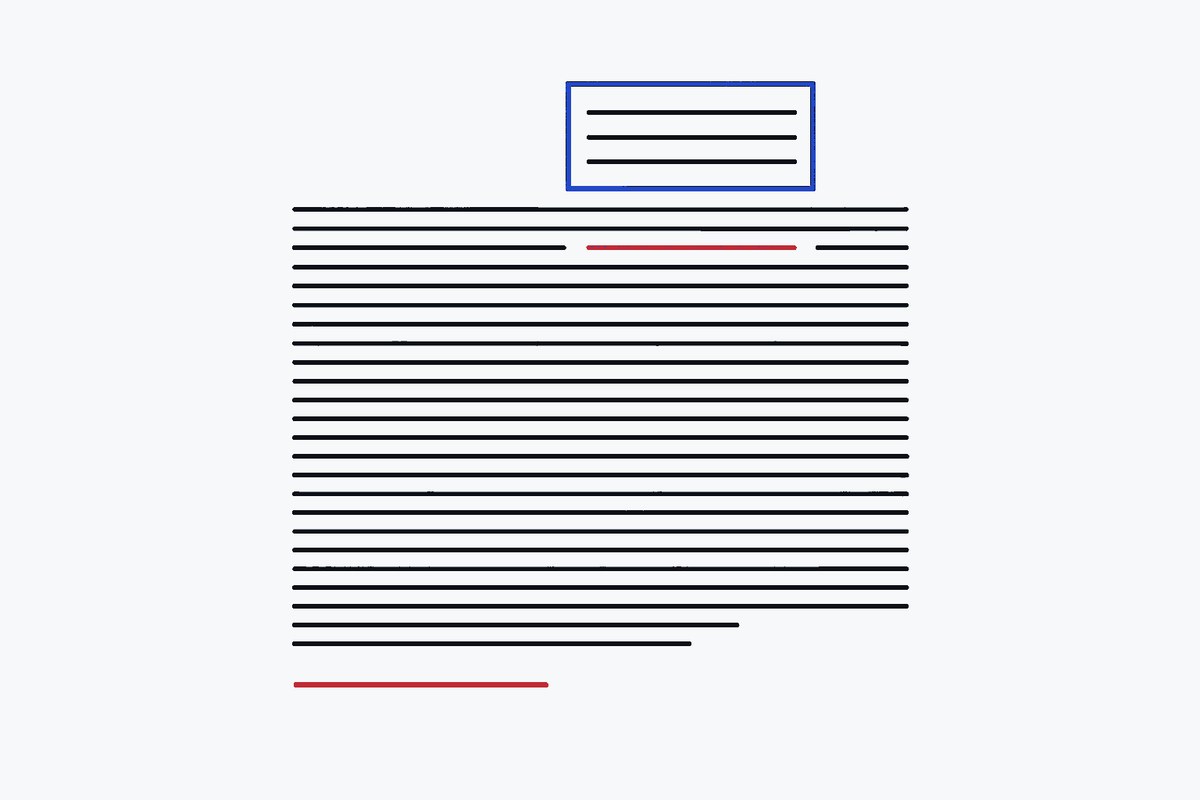
Language models do not read your page the way a person does. They retrieve chunks — passages pulled out of context — and assemble an answer from several of them. Whether your paragraph can survive that extraction decides whether it is ever used.
SearchD checks a paragraph against six properties.
| Property | What fails it |
|---|---|
| Answers one question completely | A passage that covers three things partially |
| Stands alone without the text around it | Unresolved pronouns, backward references, setup that never arrives at a claim |
| Names its subject explicitly | “the product” or “the brand” — the extracted chunk names nobody |
| Carries a number or a date | “Long-lasting and built to last through the toddler years” |
| Can be attributed to a source | A claim that points nowhere |
| Is not wrapped in page furniture | A banner, a review carousel and a related-products grid extracted along with it |
Each one gets a section below, most of them with a before and after.
Should a passage answer one question or several?
A passage that covers three things partially yields nothing. A passage that resolves one question outright is usable.
Cannot be lifted
“Sunscreen choice depends on several factors including skin type, climate, and how the product interacts with makeup, and there are trade-offs between mineral and chemical formulations that we will explore below.”
Can be lifted
“The Haruwell Daily Fluid uses chemical filters only, so it leaves no white cast at the 2 mg/cm² test application rate.”
sample
Lifted out of the page, this survives — three of the six
The Haruwell Daily Fluid is ratedSPF 50+, tested at the full2 mg/cm² application rate to the2019 edition of ISO 24444.
This does not
As mentioned above, it performs well against the standard discussed, and this is what makes it such a strong choice for the shopper described.
- Names the brandno unresolved “we” or “the company”
- Carries a numbera value that can be checked
- Carries a dateso staleness is visible
- Stands aloneno “as mentioned above”
Does a passage have to make sense without the rest of the page?
If the paragraph still makes sense with everything above it deleted, it is citable.
The killers are unresolved pronouns (“this approach”, “these products”), backward references (“as we saw above”), and setup that never arrives at a claim.
Cannot be lifted
“This is why it matters so much here.”
Can be lifted
“The Norori Wrap carrier is rated to 15 kg and tested to EN 13209-2, the European standard for soft baby carriers.”
Should a passage repeat the brand name instead of using pronouns?
Repeat the noun. Style guides tell you to vary your language to avoid repetition; extraction punishes that. If the passage refers to “the product” or “the brand”, the extracted chunk names nobody.
Cannot be lifted
“It is rated to 15 kg, and it suits newborns from 3.5 kg.”
Can be lifted
“The Norori Wrap carrier is rated to 15 kg and suits newborns from 3.5 kg.”
(The brand in these examples is invented. We are not going to assert a real company’s specification to make a point about writing.)
Does a citable passage need a number or a date?
Numbers do two things. They make a passage specific enough to be worth quoting, and they signal that a claim is checkable rather than promotional.
Cannot be lifted
“Long-lasting and built to last through the toddler years.”
Can be lifted
“The Norori Wrap carrier is rated for 15 kg, tested to EN 13209-2.”
Does a passage need a named source?
A model asserting a fact prefers a fact with a source. Where a claim comes from a standard, a test, a study or a regulator, name it inline.
Points nowhere
“Ergonomic, hip-healthy design.”
Points somewhere
“The Norori Wrap carrier is acknowledged as hip-healthy by the International Hip Dysplasia Institute, which publishes the criteria.”
Does the page furniture around a passage matter?
Chunking splits on structure. A passage sandwiched between a promotional banner, a review carousel and a related-products grid gets extracted with that debris attached, and a noisy chunk is a less attractive quote.
Keep your answer paragraphs in clean prose blocks under a clear heading, not interleaved with interface furniture.
How do I test whether my own passage is citable?
Take your highest-intent page. Copy any single paragraph into a blank document, with nothing else. Read it as though you had never seen the page.
Does it answer a question a buyer would ask? Does it name the brand? Does it contain a number? Could you repeat it aloud to someone as a fact?
Those four questions are the quick version of the six. If the answer to all four is yes, the passage is citable. Marketing copy written to be read in order rather than in fragments will fail at least one of them. Passage work is one step of six, and it comes after the cheaper ones — the full order, and the retrieval mechanism behind it, decides whether a citable passage ever gets fetched in the first place. Getting a page to pass on all six is roughly a week of writing, and it is the part of the engagement we expect to yield most — an expectation we will hold ourselves to, not a result we have measured.
Related questions
How long should a citable passage be?
Two to four sentences. Long enough to state a claim and qualify it, short enough to be quoted whole. A single sentence can lack the qualification a model needs to assert it safely; a ten-sentence paragraph gets truncated at an arbitrary point.
Does this mean I should write in FAQ format everywhere?
No. Question-shaped headings help, but a page that is nothing but a Q&A list reads as thin to a human buyer, and you should assume a ranking system can tell too. The useful pattern is normal prose where each section opens with its own answer, rather than building to it.
Will rewriting for citability hurt my rankings?
It can, if you shorten a page that ranks on depth. The safe pattern is to add an answer-first opening to each section rather than cutting the depth beneath it. Where there is a genuine trade-off we flag it rather than optimising one surface silently at the other's expense.